Archives For November 30, 1999

Most of the time less is more-in many aspects of life. This can be especially true in training.  Doing more for the sake of doing more is often times at best useless and at worst harmful.  I agree with this, but I like to think about things instead of just jumping on the bandwagon and regurgitating what is en vogue or fashionable to repeat...and right now it's fashionable to say 'less is more" for everyone.  (I even contributed to a great one of those with the Whole9, but the experts and I picked things like tgu, crawling, power clean and jerk, pull-ups, front squat-so we snuck in exercises which are multi faceted, and include many exercises in one really).

My ‘beef’ with the overwhelming number of recommendations to ‘do less’ stem from 3 main things: fun/interest, the 80/20 rule, and the sources of the initial observation that ‘less is more’.

1. Fun/interest.  You could write the perfect program that gets you big, strong and ripped, a program that only has 2 days a week, with 3 exercises ….. and it’ll be boring as shit.  Some people will counter with “is success boring? Is being ripped boring?” and I answer with “yes”.  I like training.  I like trying new stuff-it’s fun.  I’m not getting paid to compete in anything-so why would I sacrifice my enjoyment for a marginally more effective program-which is so basic that it’s boring. That perfect program from above may be cool for about 2 months, and then I wouldn’t be able to do it anymore.  Call it fitness ADD or fuckarounditis, I call it fun.  If you enjoy training, then make the focus of your workouts and exercise selection those 5 exercises, and then liberally sprinkle in things you want to do.  For instance-if you play rec basketball and want to get bigger and stronger, there are people who would argue that playing ball is counterproductive to your goals…and those people might be right from the very narrowly focused view of being big and ripped-but those people also suck and are boring.  If your only goal is to be big and ripped, I also would like to encourage you to find some more fun in life!

2. The 80/20 rule.  80% is a B-.  Those 20% that people ignore, take you from ‘ok’ to ‘good’.  They are not unimportant.  That’s why while the big bilateral lifts of pull-up, DL, Squat, Press may be enough to satisfy basic movement patterns and support good body comp and strength in those lifts.  But those 4 movements AREN’T enough to support more complicated tasks and athletics….which brings me to the next point.

3. Where did the initial ‘less is more’ observations come from?  They came from high level athletics, namely pros and collegiate strength coaches.  They noticed they got better success with their athletes when they did ‘less’ in the weight room.  And this makes sense, because the athletes are already getting tons of volume and variety of training with single leg, ballistics, agility, and reactivity being integrated in their sporting practice.  Now, ask yourself this: are you a high level athlete with matches/games and multiple practices a week where you are training ‘athletically’? If so, then you should minimize the amount of exercises and volume you add in each week…but if you are like 99.9% of the population, then you are missing the (at least) 20% of training which makes you more rounded, more able, and more athletic.  We need to stop recommending to people to do what works for high level athletes…because people aren’t high level athletes!

So there are 2 populations that should ‘do less’: beginners, and advanced*. Check out my incredibly complex graphical representation of this complex relationship and idea…
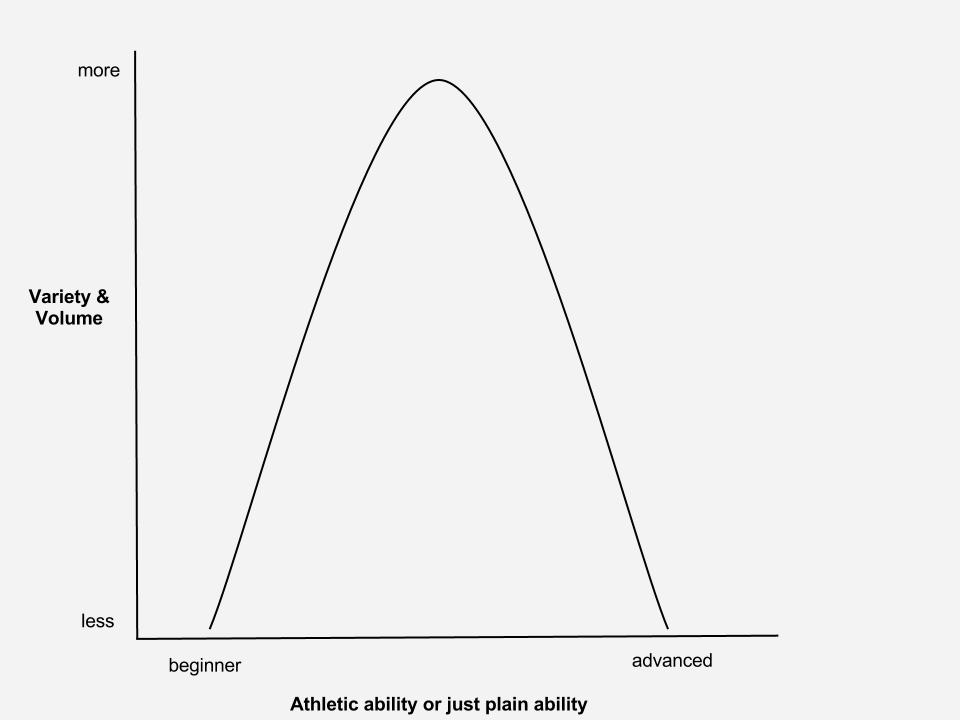
*and injured people…they should do less and get healthy.

I just read a quote from Eric Cressey regarding volume: “I’m always surprised at how much volume it takes to attain a level of fitness, but how little volume it takes to maintain that level of fitness.”

I think that most people are better off with more variety, simply because they move poorly to begin with.  If you add strength to just a select few exercises, while moving poorly in every other aspect-you are asking for trouble.  Quoting Gray Cook “Don’t put fitness on top of dysfunction.”

The main point is this: enjoy your training, train to Be Able, to Be Athletic….and once you’ve done that you can train to be Bad Ass.  If your training is hindering your achievement of goals, then it’s not appropriate…but if your goals are to enjoy your training, while getting better…then do that, don’t let people make you think you are doing ‘too much’-because they are prescribing exercise for someone else. The best form of training for you is that which you enjoy-because if you don’t enjoy it, you won’t do it.


I’d love to see some discussion about this pop up in the comments below, whether you agree, disagree, or

If you’re in San Diego..email me cliftonharski@gmail.com and I’ll help you to achieve your goals through enjoyable and effective training, if you aren’t in San Diego I’d still love to help you out through my online coaching services.

TGU>OHS

May 3, 2012 — 9 Comments

Recently, the Whole9 published a 3 part series where they asked 12 fit pros which 5 exercises they would pick if they were only allowed to pick 5, in order to promote long term health and wellness.  I rehashed that article and provided a 7 day workout split that I think would be pretty sweet, utilizing the exercises that the experts provided.

Some people really got their panties in a bunch about the exercise selections (ok, one person), specifically the predominant inclusion of the TGU.  This person was arguing that the OHS was a superior exercise for health and wellness.  I do not believe it is, and clearly the other experts didn’t either, since they didn’t place the OHS ahead of the TGU.  The TGU was picked by 5 out of the 12 experts, and the OHS squat was picked by 2.  I will guarantee that if the blog post had 10 exercises, both numbers would’ve gone up.  I would like to discuss why I believe the TGU is superior to the OHS for health and longevity-in a fairly general manner. (I’m not going to address each specific detail in depth).

But first….gotta throw out some disclaimers and notes to stop silly arguments before they arise (hopefully):

  • I’m not saying the OHS is bad.
  • I’m not saying the TGU is perfect for everyone
  • I won’t entertain arguments such as “the TGU isn’t functional because you never have to hold a weight over head while lying and stand up” because that means you are arguing for the sake of it, and we could make that silly argument for pretty much any exercise.

Let me quote Dan John on each exercise:

TGU-“The Get Up (not the “Turkish Sit Up” as I often note) is a one stop course in the basics of every human movement from rolling and hinging to lunging and locking out.”

OHS-“the overhead squat requires total concentration, total lockout and perfect positions. There is no cheating; one can’t squirm, roll the knees or hips, or let other body parts help kick in. It builds “Dad Strength.” (my note-people CAN cheat, and WILL cheat, especially at lighter loads which are deemed as progressions or termed scaled down by some-poor movement done lightly isn’t scaled down, it’s poor movement)

These two quotes illustrate why for the discussion of TGU vs OHS in health and longevity the TGU is superior.  For building total badassery, I would put them in the same space-with a caveat, you have to be able to do the OHS well!  And that isn’t actually all that easy.

OHS common issues which produce ugly/scary/shitty form

  • ankle mobility
  • hip mobility
  • thoracic/shoulder mobility
  • shoulder stability
  • core stability
  • knee stability

Tell you a secret…..the TGU will help with hip mobility, thoracic/shoulder mobility, shoulder stability, core stability, and knee stability.

You cannot just throw someone into an OHS with less weight and think that the form will   “fix itself”.  You can’t just coach some people to dorsiflex more or stay extended in their posture.  Specific mobilizations, and support drills will need to be used.  This isn’t being lazy or ignorant in coaching, it’s being realistic and thorough.  Getting good at the TGU will help you to be able to OHS squat, and you can have beginners start getting up right off the bat, you just keep the load very light, or even unloaded when needed.  That doesn’t work with the OHS because if they are too tight/weak anywhere, they won’t be able to keep a good position since the bar will be held forward of the head, and as such they’ll be engraining poor movement, which is bad…even if it’s for more reps or more weight (in the short term)!

Lower body mobility is a huge limiter for the OHS, and makes the lift potentially dangerous if you cannot get into proper position, whereas the TGU single leg positions allow people to work around and improve the limited hip mobility (and stability).  Thoracic & shoulder girdle mobility/stability demands are monstrous in the the OHS, and can lead to really shaky movement they are poor.

The TGU allows you to work on each side more specifically, and that is another reason I believe that TGU is better is because it is unilateral.  I understand that you can ultimately load more on bilateral lifts, but more isn’t always better-it’s just more.  Having single shoulder, hip, leg ability is huge!  If you always are doing bilateral lifts, you will not develop unilateral competence.  I believe transference from unilateral and single limb lifts over to bilateral or double limb lifts is greater than the opposite direction.  And, many people hide unilateral stability problems, simply by being strong and competent in bilateral lifts (for instance, two hands overhead spreading the bar is actually using the bar shape to help gain stability, which you cannot do with only one hand. The weight wants to go wherever it wants to go, and the shoulder (not just shoulder) of the arm holding that weight has to really do its job on its own).  IT IS VERY IMPORTANT TO BE STRONG UNILATERALLY!

This post is pretty rambly, and that’s fine with me, so I’ll add another point: “core” training.  Both exercises train the core because it must be stable under load and while moving up and down.  However, the TGU also has elements of rotation and anti rotation, and lateral flexion and anti flexion—which is including so many more demands than the OHS.  At heavy weight the OHS core demands ARE huge…true, but even at lower weights the TGU delivers a more comprehensive training stimulus to the “core”.

I’m happy to have a quote here from Dallas of Whole9, I almost included a picture of him here, but didn’t want the dazzling beard to take attention away from the article.

“The “best” exercises (when selecting a very short list) aren’t always the ones that generate the most power. You can’t (at least shouldn’t!) do the TGU “for time”, but you could do light OHS fast if your technique and mobility were solid. But if you’re looking to develop genuine full-body strength and stability, you do so by paying attention to detail, and scaling the load such that you must be acutely engaged in the activity (there are no mindlessly-performed heavy TGU), not simply moving more weight or doing it faster. Quality of movement matters, and the TGU is not only self-correcting at heavier loads, but it is also an elegant way to improve both mobility and full-body, multiplanar strength at the same time.”

I guess summed up: the OHS makes you more badass once you are already decently awesome, until then it may be a poor choice to include due to limitations of the trainee.  The TGU is great for just about everyone to include, and will actually help you get to the point of being able to OHS.

TGU>OHS

The Whole9 have put together an awesome 3 part series (READ THEM! 1, 2, 3) where prominent Strength & Conditioning Professionals answered the question “If you could only do 5 exercises for the rest of your life, what would they be?” Assuming your goals are general health, fitness and longevity, and not a specialized sport.  The answers were really cool, and the overlap in answers is easy to see-but I’m going to make it even easier for you below.  You’ll also notice that almost all of us who contributed to the article “cheated”….especially Dallas (it was on his site!)….we picked exercises that weren’t just one movement, we picked things that were more complicated, or we said things like “derivatives” or “variations”, and that’s because 5 isn’t a realistic thing to do for the rest of your life.  I have a post coming up on why the “less is more” idea may not be best for everyone (especially those looking for “performance”), which is sure to cause contention and discussion.  Now, on to the analysis.

Here are the raw numbers, from most to least. There were 12 experts, so a total of 60 possible exercises.  According to this, squatting is king…but we sorta knew that already, right?

Squat 7 (Overhead 2, Front 2, Goblet 1, “all” 2)

Deadlift 5

Turkish Getup 4, Pullup/Chin 4, Clean and Push Press/Jerk 4 (2 power clean, 2 full clean)

Lunge 3, Sprints 3, 1 Arm Row 3 (on trx, bent over, any)

Pushup/Plan 2, Crawling 2, Airdyne 2, Rotation/Anti Rotation 2

1 mention: Dips, Walking, Swim, 1 arm press, mobility drill from Cressey, broad jump, running, step ups, man makers

Now that we have that, let’s organize these into push, pull, hip dominant, knee dominant, single leg stance, rotational, and “core”.  This gets tricky because the complex exercises can fit into more than one category, so they can count for more than one in this section.

Push 10 (includes: presses, pushes, & crawling also)

Pull 18 (includes: DL’s, swings, cleans, pulls)

Hip Dom 8 (includes: dl’s, swings, cleans, I didn’t include the single leg stuff)

Knee Dom 7 (includes: squats, (I didn’t include the single leg stuff)

1-Leg Exercise 12 (includes: lunges, TGUs, step up, sprinting)

Rotational/Anti Rotational 15 (includes: general ro/antiro, carries, crawls, 1 arm row/press)

“Core” all of them!  The only direct core work assigned were 2 planks, and 2 specific anti rotation-however, the complex exercises chosen will handle the core.

So, looking at this we have 9:5 pull:push, 4:5 unilateral lower:bilateral lower, & a ton of ro/antiro work recommended.  So take a look at your program, and if it is missing this type of set up, understand why you aren’t quite as awesome as you’d like to be.

Next, I’m going to provide a week routine utilizing the info above, and suggest how you could incorporate this.  Now, I’m not picking 5 exercises, I already did that….I’m taking all the info from above and mashing it together in a bad ass routine, that would be great for health and wellness, and also performance (will note performance additions).  Adjust the sets & reps to fit your own personal goals and abilities, this is likely how I’d do mine, since I don’t like really high volume for my own body.  Additionally, if you can do a morning walk of 20-60 minutes while drinking coffee/tea before breakfast..please do it as often as possible-and go to http://www.mobilitywod.com/ and DO IT.

**Please please please, if any of these exercises hurt or you can’t do well, sub an easier version that you can do! **

General warm up each day (this is a tough workout load-but it’s only 3 days. the warmup alone is hard :

3 paired sets of crawling and the cressey mobility drill linked above

3 paired sets of multi directional lunges and 1 arm row variety (partial to the trx version from Dan John)

5 circuited sets of TGU on each side, 10 goblet squats & 10 swings (for added “fun”, add a press in every position in the final set of the TGU)

Monday:

5×3 Heavy Front Squats and weighted pull-ups (you’ll own the rack for a while)

8×2 Clean & Press (barbell or KB-do what you’re good at or learn the other)

1 set max rep pushups

Carry sequence: single sided 20 yard waiter walk, 20 yard rack walk, 20 yard farmers walk, same hand without putting weight down.  Do 3 sets per side.  (extra tough “performance” addition, add 5 reps of 1 arm presses before the waiter walk, 5 reps of squats before the rack walk, and 5 suitcase deadlifts before the farmer carry)

airdyne or rowing machine for 15 minutes, only breathing in and out of the nose

Tuesday:

go for a walk or a swim, and do some unweighted TGU’s and the Cressey Mobility Drill.  (“performance” add-on: hill sprints)

Wednesday:

5×3 Deadlift and single arm OH Press

3×8 Weighted chins and farmer hold step ups

10-20 single broad jumps (depending on knees and landing ability, otherwise sub heavy swings), (“performance” sub 5 sets of triple broad jumps)

sled/sandbag pushes or drags about 5 difficult sets. (“performance” add-on: hand over hand sled drags, this is a horizontal 1 arm pull, start at the end of the rope and pull the sled til its at you, do it about 3 sets per arm–or you can do the plank row)

air dyne, run or rowing machine for 15 minutes, only breathing in and out of the nose

Thursday:

go for a walk or a swim, and do some unweighted TGU’s and the Cressey Mobility Drill.  (“performance” add-on: hill sprints, do either tues or thurs, probably not both!)

Friday:

3×10 Over head squat and pullups (pullups do 1/2 of your estimated max reps)

8×2 Clean and Push Press/Jerk

1 set max out pull-up and immediately follow with max out pushups

Carry sequence: single sided 20 yard waiter walk, 20 yard rack walk, 20 yard farmers walk, same hand without putting weight down.  Do 3 sets per side.  (extra tough “performance” addition, add 5 reps of 1 arm presses before the waiter walk, 5 reps of squats before the rack walk, and 5 suitcase deadlifts before the farmer carry)

air dyne, run or rowing machine for 15 minutes, only breathing in and out of the nose

Saturday:

go for a walk or a swim, and do some unweighted TGU’s and the Cressey Mobility Drill.  (“performance” add-on: hill sprints, do either tues or thurs, probably not both!)

Sunday:

RELAX. Maybe eat some delicious ice cream.

**Again, don’t do things poorly, or that hurt!  Find a trainer that can teach you, and if you’re in San Diego…that could be me, check out the contact info**

Was really cool to jump on this podcast with Anthony Renna of the Strengthcoach podcast, http://strengthcoachpodcast.typepad.com/the_strength_coach_podcas/2012/04/episode-100.html

Thanks Ant!

TGU progress

April 16, 2012 — Leave a comment

Pretty excited that I’ve managed to get my BB getup to 64kg on each side…looking for that 70kg mark by the end of the month.  Here is a little bit of my “warmup” from yesterday.


you may have to friend me

RKCI

Cliff Harski

269 views

10/10 More Than Just a V Neck Aficionado

By Colin Cooley / Silver Spring, USA

Clif embodies everything an RKC should be: humble, attentive to detail and strong. Plus his pecs look magnificent shirtless.

Bottoms Up!

April 7, 2012 — Leave a comment

Not beer guzzling this time…just some pressing work in the gym today

Here is some discussion on FB with Ben Bruno about this

    • Ben Bruno Nice work. So far I’ve tried seated, standing, half kneeling, and floor press. I think half kneeling is the hardest of those for me. I like them all though. I’m definitely going to stick with them and see how it influences my other lifts.

    • Clifton Harski I thought they’d help push up my other lifts…but I’m not getting that actually. I can bottom up press the 36, and regular press the 40, but not press the 44!

    • Ben Bruno Interesting. When I first added in ring pushups and dips, I was horrible at them. After some practice, it got to where I can now do just about as many with rings as I can without, and my pressing went up a little bit. I’m hoping for that effect with these, but we’ll see. It’s only been a couple weeks. 36 is very strong! I can only do 20’s.

    • Clifton Harski

      I think these stability/motor control improvements don’t do enough to challenge the primary movers, and that’s why they don’t actually increase total dip amount, kb press amount etc. Now, they do allow for much better control and performance at sub maximal loads-which I believe to be hugely important to athleticism. Also, you and I are already fairly strong…so of course it makes sense that lighter loads aren’t enough to overload our prime movers in the standard version of the exercise….yet I still think these types of more proprioceptively rich, stability focused drills are important.
      57 minutes ago · Like
    • Ben Bruno Good thoughts. I also like them as a way to work through a full range of motion on a movement that otherwise might be painful with heavy weight. For example, heavy overhead work bugs my shoulder, but these are fine. After a few weeks of doing them, my shoulders already feel better and I think I’ll have a better chance of being able to overhead press if I chose to try it down the line.

      40 minutes ago · Like
    • Clifton Harski

      The bottom up overhead work really challenges those rotators, since their job is to stabilize the shoulder, and not be prime movers (primarily anyway), so for people with past rotator cuff injuries, they can be awesome (if not done too early in rehab of course). This same reasoning is why I actually like getups so much, gotta be strong and stable in many different shoulder positions

Not much of a post here, except it was cool to get on the Paleo Solution along with Erwan and Jamie. check it out!

And here is a post about it over at MovNat!

Well raised red meat helps make you more BadAss. The Harvard Study was bullshit for a number of reasons. Go buy a nice grassfed steak and feel better about yourself and be happy that a bunch of impressionable weaklings are not eating steaks leaving more for yourself and me.

I’m not nearly as smart, respected, or old as all of the people who have ripped apart the recent Harvard “red meat kills you ‘study’ ” It has generated so much buzz that even the harvard crimson is reporting on the debate.

But…I did see the Harvard scientist talk about the study and he stuck to his guns a bit again and so I felt it was needed to compile the large amount of input sticking it to the red meat scare mongers.

Side note, if you clicked the link above you would’ve noticed that the Harvard bro sports a really sweet and thick mustache that even rivals Stu McGill’s….so how is he such a boner?

In no particular order, here are a number of articles that let you know that when it comes to red meat, you should go ahead and EAT ACTUAL, WELL RAISED RED MEAT. It helps to make you more badass.

Start Here: http://www.marksdailyapple.com/will-eating-red-meat-kill-you/

Red Meat Will Kill You, and Other Assorted Fairy Tales

http://deansomerset.com/2012/03/26/my-morning-cup-of-what-the-eff-red-meat-wont-kill-you/

http://www.naturalnews.com/035310_red_meat_grass-fed_beef_processed_food.html

http://www.charlespoliquin.com/ArticlesMultimedia/Articles/Article/839/The_Red_Meat_Study_Scare_What_Do_We_Make_Of_It.aspx

http://www.gnolls.org/2893/always-be-skeptical-of-nutrition-headlines-or-what-red-meat-consumption-and-mortality-pan-et-al-really-tells-us/

Red Meat: Part of a Healthy Diet?

http://www.livestrong.com/blog/are-burgers-healthy-why-red-meat-is-not-bad-for-you/

http://agriculturesociety.com/tag/harvard-school-of-public-health/

Ok, that’s enough…turns out there were even more than I thought.


So, I’m living in Santa Fe for the next 10 weeks-without really knowing anyone except my boss….so all I plan to do is work on our business, MovNat, and sleep lots, eat healthy, and play around outside and workout hard. I also will be biking everywhere I go…at this 7,200′ altitude…so basically I am going to be in pretty decent shape. Here’s what I did today, @dan_go on twitter put up a lil challenge this morning, so I gave it a go. It hurt. I need to do that 1x per week starting now….planning it to be my sunday “thing” (unless my HRV and tap test and subjective feeling of freshness tell me not to)