Archives For November 30, 1999

Rehabbin’

July 25, 2012 — 2 Comments

So I was chatting with Sir Suppleness about icing and some other recovery things…and I ended up buying a MarcPro electrical stimulator device to use post shoulder surgery in lieu of ice, and hopefully in lieu of pain meds as well.  I really really dislike pain meds, and ice use is sorta sketchy too.  So I’ll be gritting my teeth and electrocuting myself and moving as much as possible as soon as possible to try and regain shoulder usage ASAP.  It’ll be interesting.

Mostly for my own usage, here are some interesting links about stim usage in a rehab setting.

Click to access 300PV_PostOpShldrMangine.pdf

http://www.orthogate.org/patient-education/shoulder/labral-tears.html

I’ll be posting some updates regularly on here about how the rehabbing is going. And yes, TGU’s will be part of the rehab.

Athleticism, my view

July 23, 2012 — 15 Comments

The CrossFit games just ended, and those contestants definitely contend for fittest on earth.  But, not most athletic.  In my view, neither do sprinters, high jumpers, or triathletes.  To me there is one key demand which truly tests athleticism: REACTIVENESS TO DYNAMICALLY CHANGING DEMANDS.

I am not intent on taking away any of the amazingness exhibited by competitors who sprint faster than 99.9% of humans, or can do Fran in 38 seconds (or whatever), or can do the iron cross and other crazy stuff on the rings. BUT, there is NO comparing the demands of a sport like basketball or volleyball to other events which contain no dynamic reactiveness. I’m quite sure we could take the best competitors from track and field and they would excel at football and other dynamic sports-that also is not what I’m saying. I’m saying that in my view, the pinnacle of athletic expression is tested in a dynamic field of play or demands.

For instance:

Now, in these sports which require the most athleticism as I describe above, the majority of performance happens between 50ish%-90ish% of the max effort of the athletes. The athletes must be able to fluctuate their speed, strength, effort, and relaxation in order to accomplish always changing tasks.  That IS harder and requires more athleticism than giving everything you have into one task, or even one series of predetermined tasks. This 50-90% of max effort is where the magic happens, and also happens to be where I think most athletes should be training. From a % effort standpoint, that shouldn’t be earth shattering for anyone-we all know that we want to move sub maximal loads faster/more explosively.  But what I think is this: true athleticism means being able to do more with sub maximal loads/efforts.

Examples:

  • Your max power clean is 200lbs.  Traditionally you might train weights between 100-150 focusing on speed (yes, my %’s aren’t technically exact, i’m just making a point). I believe that has it’s place and should be done. BUT, I also think those cleans should be trained with sandbags, stones, D-Balls, in different stances like a split stance—with the goal being more mastery of sub maximal efforts.
  • Your max broad jump is 10 feet.  I want you jumping between 5 and 8 feet in different directions, landing on different targets, from different approaches.  Again, I want you mastering sub maximal efforts.

Rarely does 90-100% get tested on a field/arena. 100% means lack of control to an extent-and athletes always need control.  This is a reason why sandbag and kettlebell training lends itself to athletic training so well-because they both allow for sub maximal loading in novel ways requiring additional control.  The sandbag especially tests dynamic reactive components in lifts due to its shifting nature.  I believe that we shouldn’t just try to have athletes be faster at lower %’s of weight-but to be able to demonstrate more control over their sub maximal efforts with lifts and exercises.  This gets tricky-because it will inevitably result in someone trying to juggle a kettlebell while standing on a bosu ball wearing a scuba mask—BUT, if done intelligently it can be very valuable.  What I’m talking about lies in the middle of the pendulum, where one end is very traditional “but it’s not max effort and therefore isn’t as good” thought, and the other end is the bosu ball scuba gear knucklehead.  I don’t know what the amount is where diminishing returns are seen on max loads, but it’s probably less than a lot of S&C coaches think it is.

There will be people, friends of mine, who don’t agree with this idea.  They will argue that a split stance swing doesn’t produce as much power as a bilateral stance swing, and that is true.  However, there is more going on in a split stance swing than a bilateral swing: anti rotation, higher loading on one leg, balance challenge, all of which test the athlete’s control of a sub maximal effort aka where sport happens.

Just so people don’t get mad that I didn’t list their sport: MMA, dodgeball, even baseball, basketball, football, soccer, rugby, volleyball, tag, basically anything which has DYNAMIC REACTIVE requirements.  Those requirements demand coordination, agility, and balance that CF, olyweightlifting, and other events don’t require.  Again, I’m not saying one is better or harder, because at the elite levels of track Lebron wouldn’t compete either…I’m just defining what I think athleticism is TO ME. And how I like to train it. Because unless I was competing at an elite level at one thing, I’d like to be better at the 50-90% range of what I’m doing.

This is how you’ll train if you come out to BA training classes with me in San Diego.

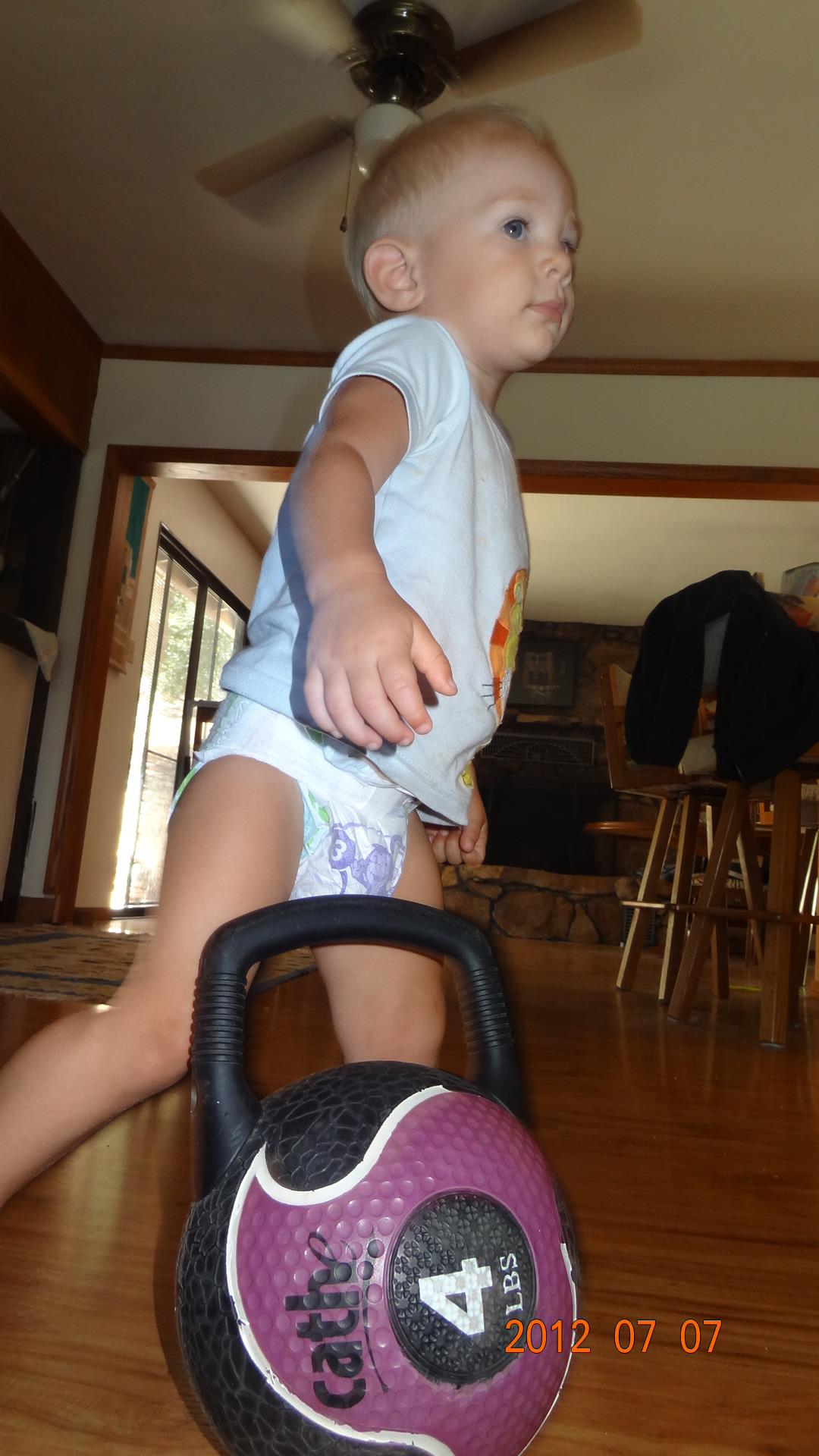
I really hope these two little people are put into some dance classes.

These are my nephews, and the reason the thought just came into my head at 7:45 am is I was up and watching dvr’d “so you think you can dance” and as I always am when watching good dancers found myself very impressed with the athleticism on display.  And it’s such well rounded athleticism: power, grace, coordination, flexibility all seamlessly blended together in an expressive way.  Contrast that with athleticism such as a triathlon: ha, no competition in my eyes-the dancers win hands down.

The specificity of movement displayed by these dancers is unbelievable. They aren’t jumping maximum heights at every opportunity, they jump an exact height.  They aren’t moving their feet as fast as possible, they are moving their feet as fast as possible in a very specific way. And they have no problem coordinating upper body moves with lower body moves.  Dance, in my opinion, is likely one of the best things that a developing child could do for movement and athleticism.  And if you could get the little boys into dance before they’re told it’s “gay” or “lame” then you would be setting them up for future awesomeness. I think dance would be equally as good for physical development as gymnastics is, specifically because it is almost the opposite of gymnastics in terms of the lack of rules.  Gymnastics development is incredible for strength, body awareness, and movement confidence, yet it is a very specific teaching process with certain predetermined important moves.  Dance allows for freedom of movement and exploration of what is possible (and to me it seems like a natural thing to encourage as young as possible since babies/toddlers dance to music on their own anyway). Imagine a young person doing both of these things-that is setting up a brain-body connection that really teaches what the body can do.

If I had to set up a PE program it would start in preschool and every year after it would include dance.  This way dance isn’t introduced once the children are 12 and awkward and scared to embarrass themselves.  If it is common place since they entered school then it shouldn’t be a big deal.  My ideal PE classes would be blends of dance, gymnastics, classic games, and sports.  And introducing organized sports isn’t a bad thing as some bozos think it is.  It’s only a bad thing when it is the only thing introduced. General athleticism was developed in me through capture the flag games in the woods, karate, PE, play, and lots of sports-I wonder how much cooler I could’ve been if dance had been in there?

Slow down please…

July 14, 2012 — 5 Comments

Those athletes, (or wannabe athletes), that you are training are amazing at how quickly they can lunge up in down in a split squat, or how quickly they can perform drop step lunges to a knee hike, or how amazing fast they can perform a bottom up KB press. Oh wait, that’s not amazing, it’s actually probably hiding some instability issues.  

Slowing a movement down takes away momentum and necessitates more control.  But you need to think about what movement you will apply this to.  For instance, some smartass is gonna tell me that “yeah but you can’t snatch slowly” to which I reply “you’re just being an asshole for the sake of being an asshole. Thanks for the useless comment, dick.”  If it’s a drill which needs explosiveness to perform, don’t slow it down.  But…..What are some drills which could benefit from slowing down the execution? Here are some that I like.

  1. Split Squats, static. Feet hip width or narrower, lowering and standing phase takes about 5 seconds each. This narrow base of support will very much see most trainees and ‘athletes’ who only train fast, max tension, and bilaterally wavering and wondering why they all of a sudden suck at life.  And that’s at bodyweight. Seriously, lots of ‘strong’ squatters can’t do this w/o falling over or at least moving their feet to shoulder width.
  2. Reverse lunges.  Step back and lower slowly to a knee ‘kiss’ then come up slowly and under control. You will have to spend extra time one 1 foot, and as such your balance will be checked. Add some more fun and hold a KB on only 1 side, either at the side, overhead, or in rack position.
  3. Rolls. Forward and backwards.  These are very interesting when done slowly.  Normally any roll practice is just throwing your body at the ground in a ball shape. Trying these drills from laying and going slowly will really test your control.
  4. Carries. You know when you are doing your farmers and rack walks you’re the person trying to ‘win’ and get to the 20 yard mark fastest. Stop it, go slower, stand up straight and enjoy the drill and it’s benefits instead of rushing through it.

Those four should give you an idea of how you can slow things down to increase the challenge. Try them out!

I’ve been a little quiet on the blogging front the last 2 months and I thought I’d share why.

I’ve been busy. Quite busy. With serious business like this picture

dangerous (I think anyway)

I was lucky enough to assist at the CK-FMS and really hammer the FMS and corrective exercise strategies into my noggin.  Out there in MN the real benefit, as is the case at any formal learning experience, was the knowledge gained between sessions through conversations with the likes of Mark Cheng, Brett Jones, and Jeff O’ Connor.  Seeing things like them constantly work on mobility drills while sitting, and jumping into learn when they could really helps solidify how important those things are.  I was really looking forward to learning from those guys at the Summit of Strength…but a pothole got in the way….

2 weeks after the ckfms I was able to attend Jason C Brown’s level 2 kettlebell athletics cert.  His material really resonated with me as I think there are a lot of things that can be done with the KB that typically are not. A small example: the KB clean just works better for some people in a straight vertical line vs the horizontal swing clean….so teaching both is rad.  Being able to do both is more rad. And being able to clean one while simultaneously snatch another is more radder.  It was the type of thing that I like and find beneficial at BA training.  And definitely a move I will be stealing for some BA training workshops that are gonna be traveling around.

2 weeks after the KB athletics cert I went to chicago for the Perform Better Summit. I’m gonna write a post about the overarching themes from that summit, but briefly: movement variability is KEY. It’s not just the thing or two that you do really well, it’s how many things you can do well. I’ve written about that before, and it’s always sweet when you have other smarter people say similar things! I also got to hang out with the Mark Fisher Fitness Crew, and we had a damn good time all weekend

Then I got home to San Diego and started working at Trader Joe’s again. Why? Because at 3 days a week I get insurance, discounted groceries, and don’t have to be my own boss for 21 hours of the week-which is very nice.  It’s nice because I’m starting my outdoor group classes (bootycamp) and that is gonna take a lot of effort and time for marketing.  It’s nice zoning out at trader joes because I’m also doing some online coaching, which I started with very few people to make sure that it would go smoothly-so far it’s been a lot of fun with great results, and I’m ready to add another 10 spots. I’m able to add more spots because I’m only coaching 6 classes per week, and not adding many 1 on 1 coaching sessions–I’ve seen just way too many trainers who get burned out living the training lifestyle.  I probably could add a bunch of clients and have crazy schedule with lots of small little breaks…but that would get old fast. So I’m building the group classes.  If you’re in San Diego, it’s $69 for a month of unlimited classes…and that’s because it takes a month to really know if we are good fits for one another, not one free class! I also like to have a month to teach you form, diet, etc.

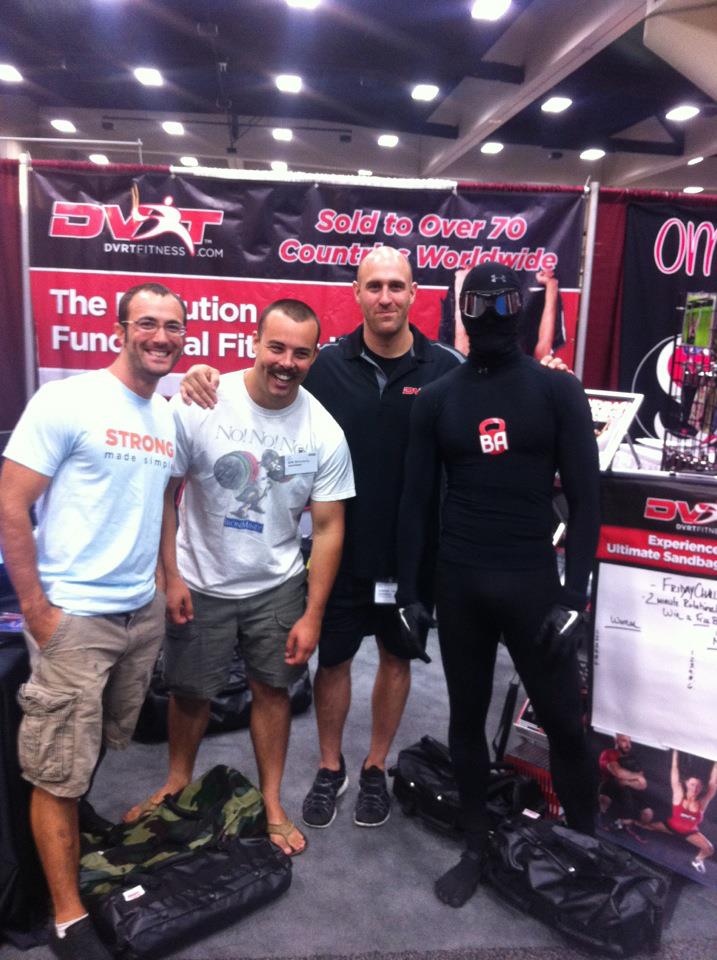
This past weekend I stormed the IDEA fitness convention center in the BA training ninja outfit

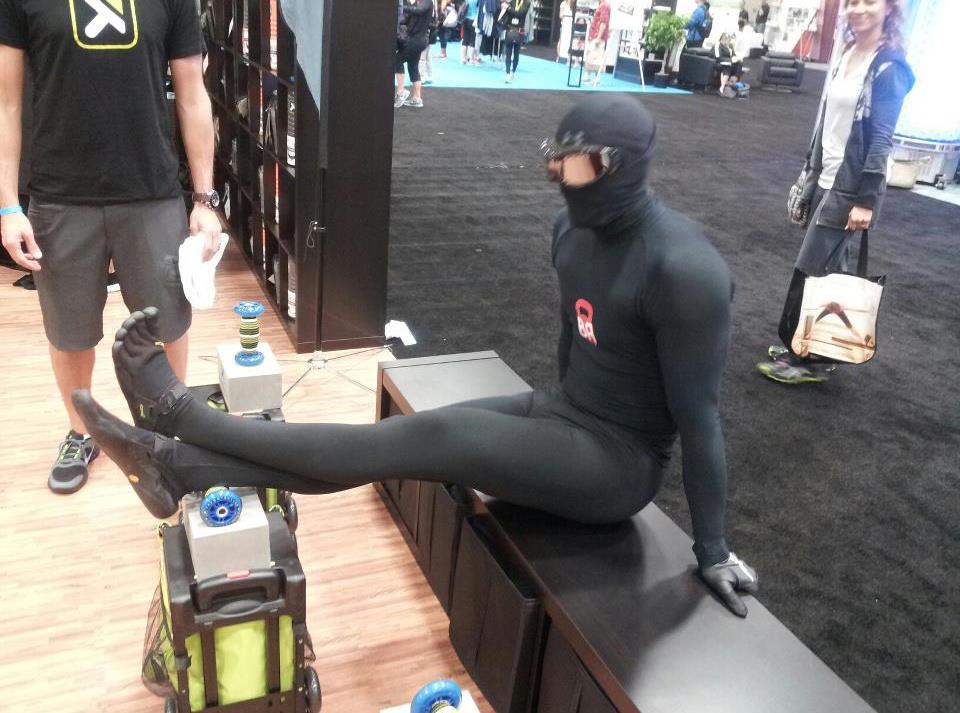
Ninjas know the importance of ankle mobility!

This coming weekend is the Josh Henkin Sandbag cert, and the following weekend is the Charlie Weingroff seminar on how to be a monster….lots of learning this summer.

And one more thing that I haven’t actually openly shared, I get knee surgery on the 25th. I had a bone bruise I suffered in december, and the bruise died unfortunately. So I’m left with a (pot)hole on the weight bearing portion of my medial femoral condyle. The plan is to go in and clean up floaties, the edges of the hole, test for health of the area, and hopefully the clean up is enough…but I might need a micro fracture procedure, or an OATS procedure.  Either of those options require 6-8 weeks of crutches, so I’m very grateful to my other coaching friends and lady who might be assisting me teach my classes while I point at the students with a crutch!

The ideas behind Paleo diet and fitness come from good natured intentions of helping people to become healthier, fitter, and experience more vitality. Sometimes the usage of the word Paleo sells ideas and products, and sometimes it drives people away.  For instance, many mainstream S&C people and diet people immediately dismiss “paleo” because they see it as silly, and will often times say things like “if you want to be a caveman why don’t you get rid of your cell phone and hunt your own food?” Which, of course, is a stupid ass thing to say-because Paleo dieters AREN’T trying to recreate living in the past….except when they are.  For example: This article saying that “backsquatting isn’t paleo” is one of those things that cheapens the entire idea of Paleo through misplaced analysis.  To this article I reply with “Who gives a shit?”  Here is a good quote from Erwan Le Corre in response to the article:

Erwan Le Corre “It makes me smile. The question, at least from a MovNat perspective, not a “Paleo” perspective, is not to debate the evolutionary nature, or naturalness of the movements of physical actions/efforts produced, but their effectiveness in term of practical performance. While Matt Metzgar, based on a naive observation, debates of the former, I train the latter. While he discusses the theory, at MovNat we train the practical. If we were to train only the movements we can see kids do, then many MovNat techniques would not be practiced, and a lot of the physical competence we’re looking for would be missing. So weighed squats not “Paleo”? Like coffee and wine? Big deal.”

Squats are good for you, and sure, you don’t see babies seeking out squat racks, but I don’t see them cooking their own food yet either.  If the Paleo crowd continues to dismiss good ideas/products just because they are modern, then the Paleo crowd will sound as obtuse, dismissive, and idiotic as the mainstream folk who dismiss ideas for having the term “paleo” attached.  Using an ancestral basis as a starting point to form ideas and try things can be useful, but does not and shouldn’t determine how we act.  Cavemen didn’t foam roll either, but I know I’m gonna keep rolling.

When teaching squats to groups I often discuss that starting a weighted squat from the bottom position more accurately emulates real life situations, such as squatting down unloaded and grabbing furniture, a child, or other things you can’t quite deadlift. I (admittedly) bring that up because many people in the Paleo and functional movement crowd really appreciate that idea (yes, I pander to the crowd!).  And switching up your squat loading can yield good results, so..

What might it look like and what are the benefits of training your squat from the bottom position? I asked my buddy Erik Blekeberg of squatmore.org and Head S&C coach at Army Navy Academy in Carlsbad, CA and here are his answers.

Erik: The zercher squat is the perfect example of a bottoms up squat. You deadlift the bar, set it on your thighs, hook your arms underneath it (now in the bottom squat position) and then stand. The zercher has the benefit of increased core activation and posterior chain loading. It is one of the perfect examples of a grind lift. Working with high school boys I often see them rely on their speed and the elasticity of their young muscles. When they miss a lift (squat, deadlift etc) they will squirm, wiggle and go limp fast. This gets corrected when we teach to grind. In the squat we teach it by doing pause squats or bottoms up. We start the bar in the bottom position and teach you to tighten and drive up.

Clifton: One of my favorite options is heavy punching bags or sandbags which are placed on a picnic bench/table where you squat down and pull the bag onto a shoulder or in tight to a bear hug then stand up with it.  Now, before you trade out your back squats for nothing but bottom up squats please understand that you’ll be missing out on some specific benefits, again, Erik provides some excellent answers.
Erik: Bottom position squats are a useful tool for teaching and training but, when looking at physical development, both for life and athletics we need to look at the benefits of loading the eccentric portion of the movements. The benefits of eccentrics have shown injury reducing (1) as well as performance enhancing (2) effects. Seeing as how sport and life consist of both a concentric and eccentric phase, one would be hard pressed to say training one is somehow superior to the other. Same with top and bottom squats. Use both when appropriate because balance and well roundedness are often the goal…oh yah and to get stronger.

In summary: don’t be a Paleo knucklehead. That is a term I just made up for a dogmatic Paleo groupie who doesn’t use all the resources he/she has available (technology, improvements in science and understanding of physiology) to make intelligent decisions and instead bases everything on an idea/ideal which doesn’t hold up to scrutiny. On the other side, don’t be an anti-Paleo dickhead…that’s a term for someone who dismisses ideas just for having a title attached to it, which means you’ll miss out on potentially good stuff just for being obtuse.

And lastly: Squatting is #BA and #PAF, so go squat something.

This jubilant fellow squatted that stone…but did so from bottom up!


1. Eccentric exercises; why do they work, what are the problems and how can we improve them?
Rees JD, Wolman RL, Wilson A.
Br J Sports Med. 2009 Apr;43(4):242-6. Epub 2008 Nov 3. Review.

2. Using Additional Eccentric Loads to Increase Concentric Performance in the Bench Throw

Sheppard, Jeremy M; Young, Kieran
Journal of Strength & Conditioning Research. 24(10):2853-2856, October 2010.

Summer Plans

June 18, 2012 — Leave a comment

Today I start training clients again in San Diego.  The Be Able group class is at 8am Mon-Thurs at Mission Bay.  It looks like a women’s only class may be in the works based on some demand…would like to hear feedback on that.

The classes have been put off for a couple reasons: getting settled back in San Diego, assisting instruction at the CK-FMS the first week of June, and dealing with an injury or two.  In fact, today at 4pm I have an MRI on the right knee which looks like it may be a meniscus tear….we’ll see.  Additionally in June I have another kettlebell certification with Jason C Brown of KB athletics which I’m excited about, and also the Chicago Perform Better Summit which I’m really pumped about because I’ll learn a ton and see some pals such as Mark Fisher, Charlie Weingroff, Gray Cook, and more.  The PB summit means I’ll be gone 5 days, and so starting July 2 the regular schedule will be up and posted.  I appreciate everyone who shares these posts and this link to the BA training Facebook page http://www.facebook.com/batrainingSD

In July I am only traveling once to take the Sandbag certification with Josh Henkin.  August will see me travel to OK City for the Summit of Strength, to Long Beach to assist Gray Cook at the perform better summit, and to NYC for Level 2 sandbag and to teach a workshop.

I’ve also taken on a handful of online coaching clients, which is proving to be very cool.  I have space for a couple more if you are interested!

Cheers

If I had one problem with the TGU, it would be that it involves no explosive element. Well, the good news is you can add a 1 arm snatch to the beginning and solve that problem.  I happen to prefer the DB snatch to the KB snatch, because I like the snatch for 1 explosive effort vs repetitive kb snatching (just my preference).  You can also 1 rep from the ground a KB, of course.  Try this one out!

Sharing

June 4, 2012 — Leave a comment

I would like to ‘blog’ more…but I don’t like sharing just for the sake of sharing, instead I want to only blog cool/smart/interesting/funny stuff…well, I am feeling like none of those things right this minute, and since it’s been two weeks of no updates due to enjoying a little time off, I am going to share a couple of Bad Ass articles by other studs I read.

  1. Patrick Ward. Like the smartest dude you don’t know about, and according to this post he’s just getting more smarter and therefore doesn’t blog that much, but when he does its golden: The Complexity of it all.
  2. Julien Smith. He has written about how to be Bad Ass, and as this blog was briefly called the Art of Badassery, you probably know I have a bit of a thing for Mr. Smith. Today he wrote about Growing Some f*c^!!g Balls.
  3. I love stuff that’s seriously geeky and sciencey like #1 Pat Ward, but even more I like someone who can take that and deliver in a totally awesome package…and the best example I’ve seen of that is Mark Fisher at www.markfisherfitness.com seriously go check it out and watch   This video should be at about 1,00,000 views it’s so damn funny. Gray himself is just rolling laughing when he shows it to me.
  4. Movementlectures.com is an unbelievable resource of affordable (cheap) lectures by all sorts of smarty pants in the health/fitness field.  Somehow they asked me to contribute, and I did here.
  5. Thanks to everyone who has reached out congratulating me on the site updates, and the training services offered.  Depending on how many of the interested people who emailed today decide to purchase online coaching, I may have to close that down for a bit due to the requests. Very cool.

Sprinting is certainly enjoying some popularity right now. Everyone in the S&C world is recommending sprinting with the following reasons (I’m sarcastically paraphrasing)

  • It’s good for your hormonal responses
  • It’s high intensity and that’s better than ‘chronic’ cardio
  • It’s time efficient

I agree with those things…BUT, I really disagree with telling people to sprint.  In over 60 workshops where I spoke about running and sprinting, I ALWAYS put out warnings that it may be a very BAD idea to starting sprinting for the majority of people.  Why? Because it’s way too intense and demanding for most people to do as is recommended.  I imagine the conversation going like this: Expert advice “You should start sprinting. It’s fast and intense and will get you ripped and explosive.”  Here is what I hear, and italics are read in sarcasm “You should start sprinting. You, who haven’t even run in years, who haven’t lunged in years, who haven’t trained legs at all in years, should start sprinting.”  To me that is irresponsible advice.  Why? Here are some reasons why it’s irresponsible advice in my opinion

  • People suck at running. Form is bad, or terrible.  How do you injure yourself? You add intensity to bad form.
  • People lack the posterior chain strength needed to sprint safely
  • People lack the single leg stability and strength needed to sprint safely
  • Professional sprinters are always hurt. And they are professionals….

Now, when I say people, I generally mean beginners.  And IMO almost everyone is a beginner.  For instance, a fantastic site with great advice is Mark’s Daily Apple, the Primal Blueprint man.  His site has changed TONS of lives for the better.  There are recommendations on that site to sprint each week-and I am uncomfortable with that because lots of people going to that site are out of shape beginners and are not ready for sprinting.**  Now the thing is this…I REALLY like sprinting, and think it IS good for everyone to do……..provided they learn how to sprint correctly and then they work their way up to it!!!

Here are my very basic recommendations to employ if you want to work up to sprinting.

  • Add in multidirectional lunges, forward, backward, crossover, and laterally.
  • Add in single leg deadlifts, hip thrusts, and KB swings.
  • Start sprinting up hill, which is quite safe because it slows you down and shortens the stride length (which means you aren’t ‘pulling’ in a fully stretched position where the hammy ouchies generally take place).  Gradually (slowly. very slowly. if ever) decrease the angle of the hill working towards flat. Read Jason Feruggia article about hill sprints.
  • If you have sand, you can sprint shorter distances on sand because it also slows you down and decreases stride length.
  • If you insist on sprinting, do 20’s, 30’s, and 40’s because you won’t even hit max speed which is safer.

Make no mistake…sprinting will help you to Be Athletic, and seriously increase your levels of BadAssery.  


I would highly recommend going to this Sprinting Instruction workshop with Franz Snideman if you get the chance to.

If you are in San Diego and you want to get some in person instruction, or if you are interested in online coaching, email me cliftonharski@gmail.com.

**I believe at Mark’s Daily Apple, there is good advice for people to NOT sprint if they are not ready for it.  This is the type of advice most people don’t follow though, because people aren’t honest with themselves.  This is why visiting mobilitywod.com and the Primal Speed workshop is so important.